Jacob Alan White

Accessible & Equitable Experiences for the Residents of Illinois
I led the creation of a comprehensive design framework and component library utilized by over 100 state agencies, enhancing the delivery of critical government services to 12.5 million Illinois residents. My leadership resulted in a 63% increase in accessibility, a 62% improvement in content quality, and a 7% rise in UX maturity.

Business & UX Impact
My redesign yielded a tangible and substantial improvement in both the quality and usability of the sites, as evidenced by measurable metrics.
63%↑
improvements in accesibility.
62%↑
improvements in quality assurance.
7%↑
improvements in UX maturity.
INDUSTRY RECOGNITION
Forbes Case Study highlighting the successful digital transformation.
Adobe Success Story showcasing the project's impact and methodology.
NASCIO Award for Elevating Accessibility for Residents with Disabilities.
The Challenge
Illinois' official state websites suffered from inconsistent and inaccessible user experiences, leading to diminished trust among citizens. The state faced potential legal actions and lagged in compliance with federal and state accessibility mandates. The urgency to modernize became even more critical during the COVID-19 pandemic, as citizens relied heavily on digital services for vital information, unemployment benefits, and public health resources.
KEY CUSTOMER CHALLENGES
Inconsistent visitor experiences across various state agency websites.
Non-compliance with accessibility standards, posing legal risks.
Fragmented content management, hindering efficient updates.
Lack of a unified design system, leading to brand inconsistency.

Vision and strategy presentation I created to drive leadership buy-in and socialize the North Star vision, ensuring alignment across stakeholders and setting a clear, unified direction for the project.
My Role & Responsibilities
Built and led a multidisciplinary team of strategists, designers, and developers.
Provided creative direction for the visual design and style system.
Developed wireframes and a component library, including defining functional requirements.
Crafted the enablement strategy and communications plan for content creators.
Formulated a migration strategy to drive adoption and user engagement.
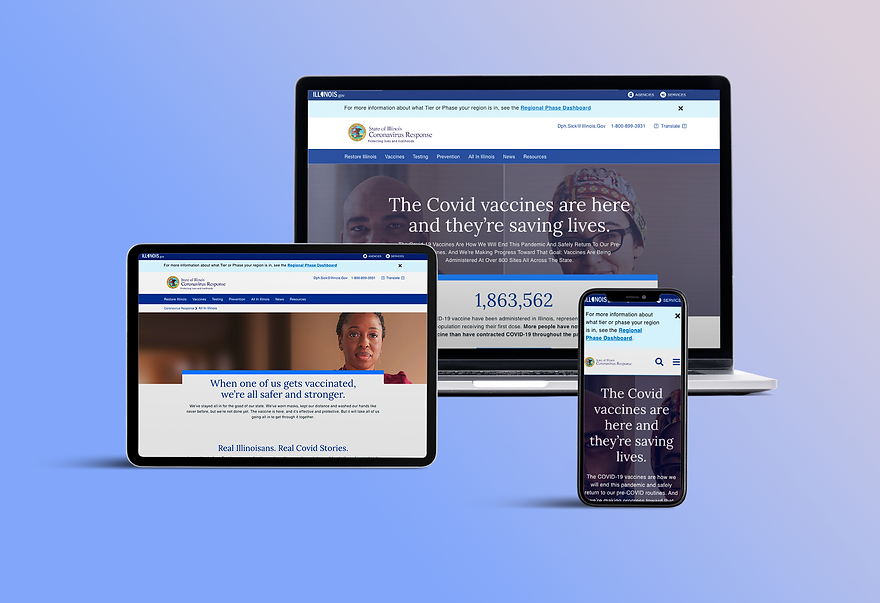
Final design of one of over 100 sites I created using the design framework I developed. This framework enabled state agencies to conceptualize, design, and deploy their websites online while effortlessly adhering to consistent state brand guidelines, maintaining their own identity, and meeting accessibility standards.
Research & Discovery
To ground the redesign in user needs and business objectives, I led a comprehensive discovery phase:
STAKEHOLDER ENGAGEMENT
Conducted workshops and interviews with stakeholders across key government agencies to understand their goals and challenges.
Identified measurable success factors to assess the legacy experience and validate the redesign's effectiveness.
USER OBSERVATIONS
Analyzed citizen feedback to identify pain points in accessing online government services.
Assessed accessibility compliance to determine gaps and areas for improvement.
KEY RESEARCH FINDINGS
Inconsistent design and navigation across agency websites led to user confusion.
Significant accessibility issues prevented equitable access to information.
Decentralized content management resulted in outdated and inconsistent information.

I focused our research efforts on two critical agencies: the Department of Public Health and the Employment Security Office. The journey mapping workshops and stakeholder interviews we conducted not only helped these agencies but also allowed us to apply those insights to our design system, ensuring that all Illinoisans could benefit from a more accessible and user-friendly experience.
"As more and more physical locations closed, our residents demanded growing functionality and abilities from our public sites. Partnering with this design team allowed us to quickly meet those challenges and address long-standing issues with our most critical websites."
Brandon Ragle
Acting State CIO
Design Process
DEFINING THE VALUE FRAMEWORK
Transformed the Web Services organization into a dynamic enterprise content management team.
Established measurable impact metrics to guide the redesign process and gain leadership support.
CREATING THE MIGRATION FRAMEWORK
Developed a templatized approach for content migration, ensuring scalability and repeatability.
Adopted by Adobe as the official methodology for large-scale content migrations
DESIGN SYSTEM DEVELOPMENT
Crafted a citizen-centric design framework prioritizing accessibility and usability.
Established a comprehensive component and template library to ensure consistency across agency websites.
WIREFRAMING & PROTOTYPING
Developed wireframes detailing layouts, navigation, and content structures.
Created interactive prototypes to facilitate usability testing and stakeholder feedback.

The extensive component and template library I developed with implementation and usage details.

Additional site design examples.
Empowering Content Creators
Recognizing the pivotal role of content creators, I led initiatives to:
Develop a comprehensive enablement strategy to empower content authors.
Create educational materials and training programs to ensure effective use of the new design framework.
Implement a communication plan to keep stakeholders informed and engaged throughout the transformation process.

I also led the creation of online documentation and training guides (all built with the design framework) to enable content authors, site creators, and agency leadership to onboard and adopt the system more quickly and efficiently.
Final Thoughts
This project was a testament to the power of human-centered design in driving meaningful change at scale. With millions of Illinois residents relying on the state’s digital services, the challenge was not only to improve accessibility and usability but also to ensure equitable access to critical resources. By leading research-driven UX improvements, developing a more intuitive authoring experience, and implementing a scalable design system, I helped transform the state’s digital experience into one that is more inclusive, efficient, and user-friendly.
The success of this initiative reinforced my passion for creating digital experiences that serve diverse populations while driving measurable impact.